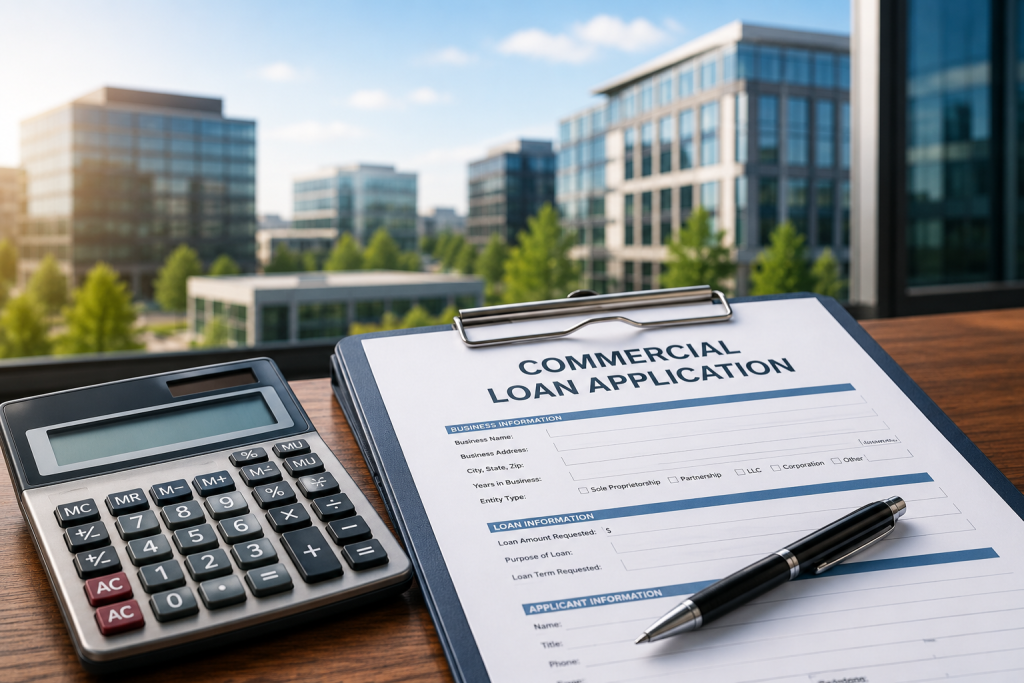
Whether you’re purchasing an office building, a retail strip center, or a multifamily apartment complex, commercial real estate loans work very differently from the residential mortgages most people are familiar with. Understanding how they’re structured — and what lenders look for — can mean the difference between closing a deal and walking away empty-handed.
This guide breaks down the essentials of commercial real estate financing so you can approach lenders with confidence.
What Is a Commercial Real Estate Loan?
A commercial real estate (CRE) loan is a mortgage secured by income-producing property rather than a primary residence. Lenders use the property itself — and the income it generates — as the primary basis for underwriting the loan.
Commercial loans are typically used to purchase, refinance, or renovate:
- Office buildings and coworking spaces
- Retail centers, strip malls, and storefronts
- Industrial warehouses and distribution facilities
- Multifamily apartment buildings (5+ units)
- Hotels and hospitality properties
- Mixed-use developments
Types of Commercial Real Estate Loans
Not all commercial loans are the same. The right product depends on your property type, timeline, and financial profile.
Conventional Commercial Mortgages
Offered by banks and credit unions, these loans typically require 20–30% down and are best for established borrowers with strong financials. Terms usually run 5, 7, or 10 years with a 20–25 year amortization schedule and a balloon payment at maturity.
SBA 504 Loans
The Small Business Administration’s 504 program is designed for owner-occupied commercial properties. It pairs a conventional bank loan (50%) with a certified development company (CDC) loan (40%), requiring only 10% down from the borrower. These loans offer long amortization periods — up to 25 years — and competitive fixed rates.
SBA 7(a) Loans
More flexible than the 504, a 7(a) loan can be used for real estate, equipment, or working capital. Loan amounts go up to $5 million, and the SBA guarantee makes it easier for smaller businesses to qualify.
CMBS Loans (Commercial Mortgage-Backed Securities)
CMBS loans are pooled and sold to investors on the secondary market. They often offer competitive rates and can be used for larger properties, but they come with strict prepayment penalties and limited flexibility during the loan term.
Bridge Loans
Short-term financing (typically 12–36 months) used to acquire or stabilize a property before securing permanent financing. Bridge loans carry higher interest rates but can close quickly — often in weeks rather than months.
Hard Money Loans
Asset-based loans from private lenders that prioritize the property’s value over the borrower’s credit. Higher rates and fees, but useful for distressed properties, quick acquisitions, or borrowers who can’t qualify through traditional channels.
Key Loan Terms to Know
Loan-to-Value (LTV): The loan amount as a percentage of the property’s appraised value. Most commercial lenders cap LTV at 65–80%, meaning you’ll need 20–35% equity or down payment.
Debt Service Coverage Ratio (DSCR): The ratio of a property’s net operating income (NOI) to its annual debt service (principal + interest). Lenders typically require a minimum DSCR of 1.20–1.25, meaning the property must generate at least 20–25% more income than is needed to cover the loan payment.
Amortization vs. Loan Term: Unlike a 30-year residential mortgage, most commercial loans have a shorter term (5–10 years) with a longer amortization (20–25 years). At the end of the term, the remaining balance comes due as a balloon payment, requiring a payoff, sale, or refinance.
Prepayment Penalties: Many commercial loans restrict early payoff through defeasance, step-down penalties, or yield maintenance clauses. Always review prepayment terms before signing.
What Lenders Look For
Commercial lenders evaluate both the property and the borrower. Expect scrutiny on:
Net Operating Income (NOI): Your property’s gross rental income minus operating expenses (taxes, insurance, maintenance, management fees). NOI drives everything.
Occupancy and Lease Terms: A fully leased building with long-term, creditworthy tenants is far easier to finance than a vacant property. Lenders want to see stable, predictable cash flow.
Borrower Financials: Personal or business tax returns (2–3 years), personal financial statements, and your credit history all factor in — especially for smaller loans.
Property Condition and Type: Class A assets in strong markets are easiest to finance. Distressed, specialized, or rural properties may require alternative lenders.
Experience: First-time commercial investors may face higher down payment requirements or need a co-sponsor with a track record.
The Application Process
Commercial loan applications are more complex than residential ones. Here’s what to expect:
- Pre-qualification — Share basic financials with the lender to get a preliminary sense of loan size and terms.
- Letter of Intent (LOI) — Once you have a property under contract, submit a formal loan request with property details and pro forma financials.
- Underwriting — The lender orders an appraisal, environmental report (Phase I), and title search, and reviews your financials in depth. This can take 30–60 days.
- Commitment Letter — The lender issues a commitment outlining final terms, subject to conditions.
- Closing — Final review of documents, title, and insurance, followed by funding.
Finding Distressed Commercial Properties to Finance
Some of the best commercial real estate opportunities come from distressed or foreclosed properties — buildings where the prior owner defaulted on their loan and the lender is motivated to sell quickly, often at a discount to market value.
Commercial foreclosures follow the same judicial or non-judicial process as residential foreclosures, but with some important differences. Commercial properties don’t benefit from the mandatory settlement conference process that extends residential timelines in states like New York. Lenders can move faster. In non-judicial states like Texas, a commercial property can go from default to trustee sale in 60 to 90 days.
Types of distressed commercial property worth tracking:
- Bank-owned (REO) commercial properties — lenders that took back a property at auction are motivated sellers, often pricing below market to clear the asset from their books
- Pre-foreclosure commercial properties — owner still holds title but is behind on payments; motivated to sell before the lender forces the issue
- Tax-defaulted commercial properties — properties with delinquent property taxes sold through county tax auctions, sometimes at significant discounts
- Note purchases — buying the distressed debt (the mortgage note) rather than the property itself, then working out or foreclosing to take title
Land.net tracks foreclosure listings nationwide including commercial and investment properties — browsing by state, county, or city can surface opportunities before they appear on MLS.
Common Mistakes Commercial Loan Borrowers Make
After decades in real estate, the same mistakes come up repeatedly with commercial financing:
Underestimating the timeline. Commercial loan underwriting takes 30 to 90 days minimum. Buyers who tie up a property under contract without a financing contingency, then discover their loan won’t close in time, lose deposits. Build realistic timelines into your purchase agreements.
Ignoring the debt service coverage ratio. Many buyers focus entirely on purchase price and overlook whether the property’s income actually supports the loan payment. A property that pencils at 6% cap rate may not qualify for financing if the DSCR falls below 1.20. Run the numbers before you make an offer.
Not shopping lenders. Commercial lending rates and terms vary dramatically by lender, property type, and borrower profile. A community bank may offer significantly better terms than a national lender for a local retail strip center. A CMBS lender may offer better rates for a larger multi-tenant property than either. Get multiple quotes.
Overlooking prepayment penalties. A 5-year loan with yield maintenance or defeasance can make early exit extremely expensive. If your business plan involves selling or refinancing within 3 years, make sure your loan structure allows it at acceptable cost.
Skipping the Phase I environmental report. Most commercial lenders require a Phase I Environmental Site Assessment. If the Phase I reveals potential contamination and triggers a Phase II investigation, closing can be delayed significantly — and if contamination is confirmed, the deal may fall apart entirely. For industrial or former gas station properties, order the Phase I early.
Questions to Ask Every Commercial Lender
Before committing to a commercial loan, get clear answers on:
- What is the maximum LTV for this property type and location?
- What DSCR do you require, and how do you calculate NOI?
- Is the rate fixed or floating, and for how long?
- What are the prepayment penalty terms?
- What is your typical timeline from application to commitment?
- Do you require personal guarantees, and under what circumstances?
- What happens at the balloon payment maturity date if I need to extend?
Bottom Line
Commercial real estate loans are more complex than residential mortgages, but the structure is logical once you understand the underlying principles: lenders care about the property’s income, its value relative to the loan, and the borrower’s ability to manage and maintain the asset. Master DSCR, LTV, and NOI — and know your loan type before you approach a lender — and you’ll walk into the process positioned to close.
For buyers purchasing distressed commercial properties, financing options include the same conventional, SBA, and bridge products described above — plus hard money and private capital that can close quickly on auction or REO purchases. If you’re looking to match your specific commercial financing need with lenders, C-Loans.com is a free service that connects commercial borrowers with lenders nationwide.